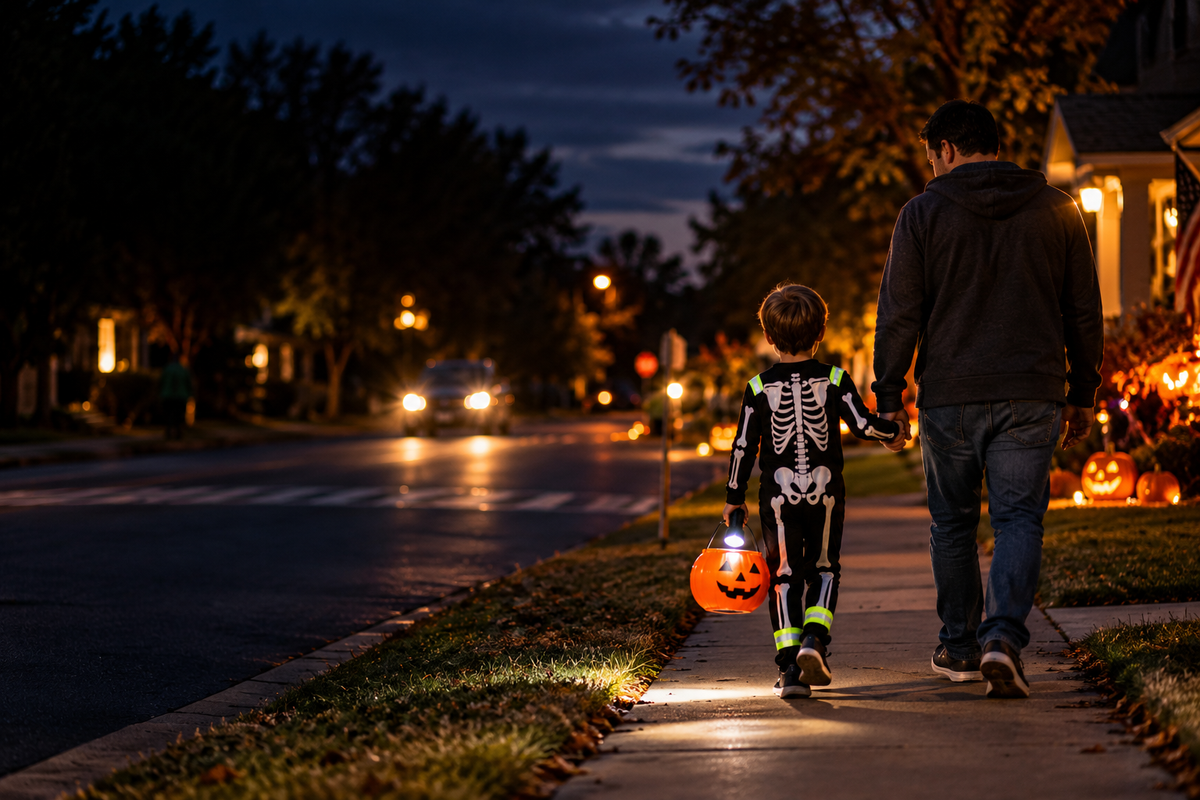
Halloween is this Friday. And if you've got kids, you're probably thinking about costumes, candy routes, and whether it's going to rain. That's exactly what you should be thinking about — it's a fun night, it's a tradition, and most families are going to have a great time.
But there are a few things about Halloween night that the data shows, year after year, that most parents genuinely don't know. Not the stuff that gets talked about every October — the strangers, the tampered candy, the horror movie fears. The actual things that send kids to the emergency room and, in the worst cases, don't bring them home.
We're writing this because awareness genuinely saves lives on October 31st. Not because we want to stress you out before the weekend.
The Number That Stops Parents Cold
Here it is: children are more than twice as likely to be hit and killed by a car on Halloween than on any other day of the year. That's not a rough estimate — it's been documented consistently by the National Highway Traffic Safety Administration (NHTSA) and confirmed by Safe Kids Worldwide over decades of pedestrian fatality data. Halloween is one of the top three most dangerous days of the year for pedestrian injuries and fatalities, period.
The peak danger window is between 5 PM and 9 PM. The single most dangerous hour is right at dusk — 6 to 7 PM — when darkness is falling, kids are in dark costumes, and they're running between houses too excited to look both ways. Children between ages 4 and 8 face a tenfold increase in pedestrian fatality risk during that window compared to a regular evening.
Ten times. On a night most families think of as completely safe.
The reason this doesn't get more public attention is that it doesn't happen as one event. It's one child here, one there, spread across thousands of neighborhoods on a single night. No single headline captures it. But the pattern in the data is completely consistent, and it points directly at something that's almost entirely preventable.
The Drinking Problem Nobody Mentions
Here's the other side of the Halloween equation that tends to fly completely under the radar: Halloween has become one of the top drinking holidays in the United States. Adult costume parties, bar crawls, neighborhood gatherings — by 6 PM on October 31st, a meaningful number of the drivers on those residential streets have been drinking since the afternoon.
The NHTSA numbers are not subtle about this. More than 40% of fatal car crashes on Halloween night involve drunk drivers. Between 2018 and 2022, there were 386 traffic fatalities on Halloween night — and 52% of vehicle occupants involved in those crashes were drunk. In 2023 alone, 29% of all fatal Halloween crashes involved impaired drivers, according to the most recent MADD report.
And here's the stat that genuinely surprises most people: drunk driving deaths on Halloween are statistically more common than on New Year's Eve. Halloween doesn't carry the same cultural warning about not drinking and driving — it's associated with children and candy, not nightlife. So the adult drinking side of it tends to happen quietly, and then those same adults get in their cars to drive home through neighborhoods full of kids in dark costumes.
The age group most overrepresented in drunk driving fatalities on Halloween? 21 to 34. The same people at the adult costume parties. In some states, law enforcement runs coordinated Halloween DUI enforcement specifically because of how consistently the data shows up — Arizona alone made over 160 DUI arrests on Halloween 2024 and the morning after.
Fireworks and Sparklers: The Underrated Hazard
This one surprises people. Fireworks and sparklers at Halloween have become increasingly common — block parties, community events, front yard celebrations. And every year, the Consumer Product Safety Commission tracks an October uptick in fireworks-related injuries outside of the expected July 4th peak.
Sparklers are the sneaky one. They look harmless. Parents hand them to kids all the time. But sparklers burn at up to 1,800 degrees Fahrenheit — hot enough to melt certain metals — and they're responsible for a disproportionate share of hand, face, and eye injuries in children. The injuries happen fast, they happen to distracted kids, and they happen at exactly the kind of chaotic, loud, exciting events where supervision tends to drift.
Emergency rooms report a 15% increase in overall visits on Halloween night compared to a typical night. Burns, cuts, falls, head injuries from running in the dark — most of it completely preventable with basic attention that's genuinely hard to maintain when you're managing multiple excited kids in a crowd.
What Actually Happens Crime-Wise on Halloween
Every October, the conversation about Halloween crime focuses on tampered candy, predators, and strangers. Research consistently shows that's not where the actual risk is.
A comprehensive study analyzing over 5 million crimes across 30 states in and around Halloween found the most common criminal activity that night is: theft (32%), property destruction and vandalism (21%), and assault (19%). The theft spike is real — 1 in 4 theft incidents on Halloween occur on October 31st itself. Unlocked cars, unattended bags, porches left empty while families are out trick-or-treating. It's opportunistic and it follows the crowds.
The feared predator scenario — strangers targeting children specifically on Halloween night — is not what the crime data shows. Comprehensive research covering nearly a decade of national crime records found no statistically significant spike in non-familial crimes against children on Halloween compared to other days. Basic supervision still applies, always. But the specific fear that Halloween is uniquely dangerous because of strangers is not supported by the numbers. The cars and the drunk drivers are far more documented, far more consistent, and far more preventable.
What You Can Actually Do About It
We're not going to hand you a 40-point checklist. Most of those are noise. Here's what the data actually points to as the things that matter most.
Visibility is everything. Dark costumes, no flashlights, no reflective material — that's the setup for most pedestrian tragedies on Halloween night. Reflective tape on costumes and treat bags costs nothing. A flashlight or glow stick for every kid changes how visible they are to drivers dramatically. This is the single highest-leverage thing you can do before you leave the house.
Cross at corners, every time, no exceptions. Kids run ahead. Kids dart across mid-block. Kids assume cars see them. That behavioral pattern is behind most of the Halloween pedestrian data. Slow it down, walk with them, enforce the crossing rules even when it feels like overkill.
If you're driving that night, drive like kids are going to run into the street without looking. Because statistically, some of them will. Slow down in residential neighborhoods, stay off your phone, give trick-or-treaters way more space than feels necessary. And if you've been drinking — get a rideshare. Not because you think you're too drunk. Because the data doesn't come from people who knew they were too drunk.
Lock up before you leave. If your whole family is going out, don't leave the front door unlocked, bags on the porch, or cars open. A lit house with no one home on Halloween night reads differently than you'd think.
Sparklers stay away from kids under 12. If your neighborhood event has any open flame or fireworks, designate one adult whose only job is keeping the kids back. Not watching from nearby — actually positioned between the kids and the fire.
Have a Great Night
Genuinely — Halloween is fun, and for most families most years it goes exactly the way it should. The point of knowing the actual risks isn't to spend the night anxious. It's to spend it smart, so the few precautions that actually matter get taken before you walk out the door.
The cars are the real danger. The light-up costume accessories are worth it. The reflective tape takes two minutes. And the drunk driving piece is on all of us — if you're at a Halloween party this weekend, plan your ride before you get there.
Stay safe out there. Save some of the good candy.
Resources Worth Bookmarking
- NHTSA Halloween Safety Tips — official pedestrian and traffic safety guidance from the National Highway Traffic Safety Administration
- Safe Kids Worldwide — child safety research, Halloween-specific pedestrian guides, and free reflective materials programs in many cities
- MADD — Mothers Against Drunk Driving — drunk driving statistics, awareness campaigns, and resources for planning a sober ride home
- U.S. Consumer Product Safety Commission — Halloween Safety — costume safety standards, fireworks and sparkler guidelines, and injury prevention
- American Red Cross — Halloween Safety — practical family preparedness guide including what to do if something goes wrong